

How should a cannabis business manage invoices and bill pay?
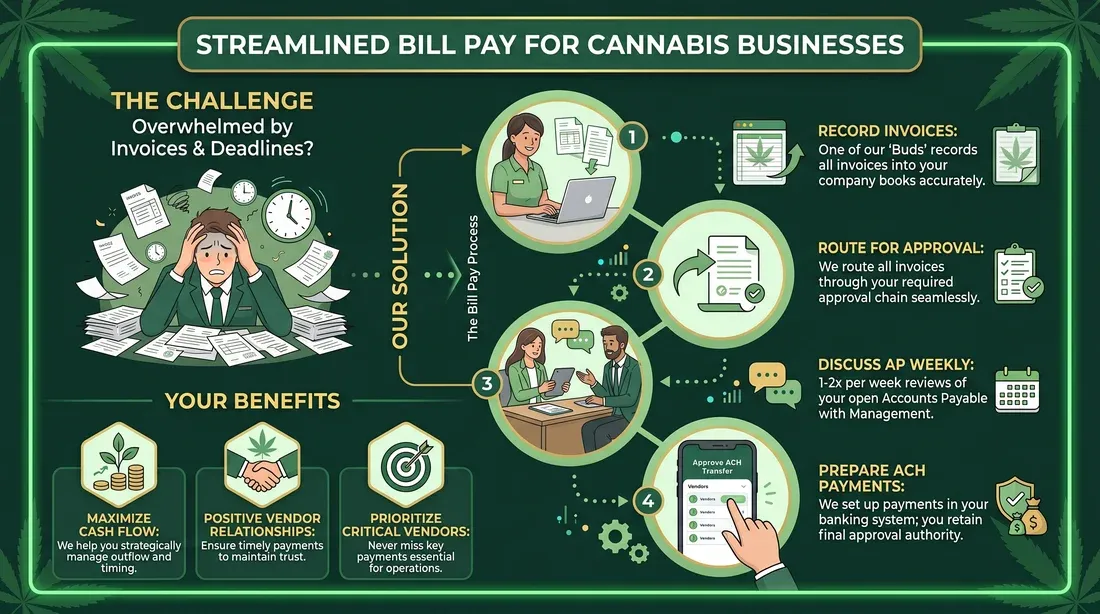
Use a set workflow that separates recording, approval and payment. We record every vendor invoice in your books as it arrives, coded for 280E, route it to the approvers you choose, review open payables with management once or twice a week, and prepare ACH payments in your bank for your signers to release. You keep control of every payment and gain a clean, documented payables process.
Federal banking restrictions, cash-heavy operations and 280E make payables harder to manage in cannabis than in other industries. Many operators still pay some vendors in cash, bank with a limited set of cannabis-friendly institutions, and need every invoice coded correctly for federal and state tax purposes. A missed or miscoded invoice costs more here than elsewhere.
What’s included
- Recording every vendor invoice in your books as it arrives, with the expense or inventory account set for 280E.
- Routing invoices for approval under the policy you define.
- Reviewing open payables with management one to two times a week.
- Preparing ACH payments in your existing banking system.
- Final approval and release by your authorized signers.
- Capturing vendor data (W-9s and payment totals) for year-end 1099 filing.
How we work
Record
Each invoice is entered when received, with vendor, amount, due date and account coding. Invoices that duplicate earlier bills or do not match agreed terms are flagged rather than processed.
Route for approval
Invoices go to the approvers your policy names, whether that is one person, dollar thresholds or vendor categories.
Review payables weekly
We walk management through what is open, what is due and what cash supports this week, so payment timing is a decision, not a reaction.
Prepare and release
We prepare ACH payments in your bank. Your signers release them. Cash payments are documented with the invoice and a receipt and recorded at the same level of detail.
Who it’s for
Dispensaries with high vendor invoice volume, and cultivators, processors and multi-entity operators that want a controlled payables process without adding staff.
Why it matters for cannabis operators
- 280E coding at entry: where 280E applies, whether a cost belongs in inventory decides whether it reduces federal taxable income.
- Cash documentation: cash disbursements need the same paper trail as electronic payments to support your return and state reporting.
- Segregation of duties: separating recording, approval and release is a basic control that state regulators and lenders expect to see.
- Seed-to-sale link: invoices for product and packaging should tie to the inventory recorded in your tracking system.
Frequently asked questions
What does the Invoicing & Bill Pay service include?
Five activities. We record every invoice in your books as it arrives, route it for approval under your approval policy, review open accounts payable with management one to two times a week, and prepare ACH payments in your banking system. Your authorized signers give final approval and release each payment.
Why do cannabis businesses need a dedicated bill pay service?
Because keeping invoices paid on time takes more attention than most cannabis teams, especially dispensaries, can spare. Cannabis operators also deal with vendors other retailers rarely see, such as compliance software providers, security firms and packaging suppliers subject to state labeling rules. Each of those invoices has to be documented and coded correctly for 280E and state reporting.
How does the approval process work?
It follows your policy. Some clients use one approver for everything, others route larger invoices to executives and smaller ones to operations managers, and others route by vendor category. We set up the routing you choose and never decide on your behalf what gets paid.
How are invoices coded in the accounting system?
At entry, with vendor, amount, due date and the expense or inventory account captured. In cannabis that coding decision matters more than in most industries, because where 280E applies an invoice for packaging that goes into Cost of Goods Sold is treated differently from one for office supplies. Getting it right at entry avoids recoding at year end.
Do you handle accounts receivable as well as payables?
The Bill Pay service covers accounts payable. Customer invoicing, receivables tracking and collections are scoped separately because the cadence and risks are different. Dispensaries that collect at the point of sale carry little receivable, while wholesalers, cultivators and processors selling to other licensees often need active receivables management.
How often will I hear from you about open payables?
One to two times a week. Each review is a short, structured look at what is open, what is coming due, what needs approval and what your cash position supports this week. Missing a payment to a security provider, compliance vendor or key supplier has operational consequences beyond a late fee, so we keep that visibility constant.
How does the service protect against fraud and payment errors?
By separating duties. We record invoices and prepare payments, your management approves them, and your bank executes the transfer after your signers release it. Because no single person records, approves and releases a payment, an erroneous or fraudulent transaction has no unchecked path through the process.
What if I pay some vendors in cash?
We capture the invoice, document the cash payment with a receipt, and record it at the same level of detail as an electronic payment. That keeps cash disbursements visible in your controls and correctly coded for 280E and state reporting. Federal banking limits mean many cannabis operators still pay some vendors in cash, so this is a standard part of the process.
Can you track vendor data for Form 1099 filings?
Yes. Bill pay is the natural place to collect what 1099 filing needs: vendor type, entity structure, a Form W-9 on file and cumulative payments by vendor. When bill pay and bookkeeping run in the same place, the data is consistent all year and year-end 1099 preparation is straightforward. Filing dates are on our 2027 tax deadlines page.
How does bill pay help my cash flow?
It turns payables into a cash planning tool. The weekly review lets you sequence payments deliberately, putting critical vendors first, instead of paying whoever calls first. With high tax and operating costs in cannabis, that weekly discipline is part of keeping enough cash for tax payments and inventory.
Do I have to change banks?
No. We work inside your existing banking system. Most licensed operators worked hard to establish a relationship with a bank or credit union that accepts cannabis deposits, so we prepare payments there and your signers release them there.
Can you manage bill pay across multiple entities?
Yes. Many cannabis operators run separate entities for cultivation, processing, retail and real estate, each with its own bank accounts and vendors. We handle each entity's payables in its own books and banking environment under one engagement, with the same process, controls and reporting across all of them.
How quickly is an invoice processed?
We record invoices as they arrive, so each one enters your approval workflow right away. Once approved, the ACH is prepared and held for your release. The main variable is your own approval time, which is by design: you make every payment decision.
What happens when an invoice is wrong?
We flag it instead of processing it. Duplicate bills, pricing errors and invoices that do not match agreed terms are raised at the next payables review, and you decide how to handle the vendor. Many cannabis vendor relationships are long-running and important, so you stay in charge of those conversations.
How is the Bill Pay service priced?
We scope it on your invoice volume, the number of entities and bank accounts, the complexity of your approval workflow, and whether it runs on its own or alongside our bookkeeping. When you compare costs, include the time your team spends managing payables today.
How do I move my bill pay to Buds Group?
We start with a discovery call covering invoice volume, vendors, accounting software, banking platform and current approval workflow. Then we document your approval policy, set up access at the right permission levels and start the weekly review. During handover we review vendor records, confirm payment terms and align expense coding with 280E.